
Have you ever found yourself setting goal after goal with no real endgame in sight? You hit one milestone, only to immediately move on to the next hoping this one finally brings happiness. Maybe you wake up each day working endlessly toward “success,” only to arrive at burnout, confused about where things went off track.
If you’re nodding along, please know this: I see you—and you’re not alone.
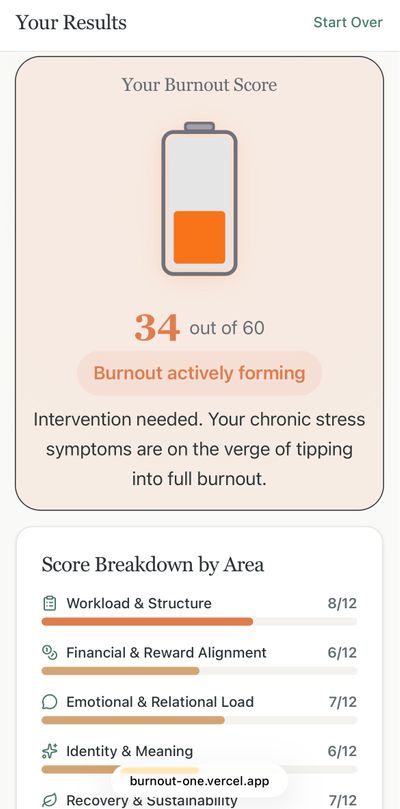
That's why I, Chris Mahoney, and Heather Bagby put our minds together to create a helpful tool, The Summit Owner Burnout Diagnostic, a quick research-informed, 3-minute assessment that evaluates five key leadership areas (learn more about this tool at the end of this blog).
For many high-performing leaders, the very traits we’re proud of—drive, ambition, responsibility— can sometimes keep us stuck in a cycle. A cycle psychologists call the Hedonic Treadmill (Brickman & Campbell, 1971). Picture yourself running for hours… you’re sweaty, exhausted, pushing hard— only to step off and realize you’re standing exactly where you started! For leaders experiencing burnout, this metaphor often feels painfully accurate.
The Hedonic Treadmill & Why Leaders Get Stuck
The Hedonic Treadmill describes our tendency to return to a baseline level of happiness after both positive and negative life events (Brickman & Campbell, 1971). For example, a service provider earns a promotion to Level 2, and three months later in a one-on-one, shares that they still feel “stuck” or thought the promotion would “feel different”.
When we return to our baseline of happiness, we often respond by setting another goal—hoping that achievement will finally make us feel fulfilled. And then another. And another.
Salon leaders are especially vulnerable to this cycle because of a few common beliefs:
- The “Only One Me” belief – feeling stretched too thin without systems in place to support you or your team.
- The “Never Enough” mindset – time, energy, money, or capacity always feels scarce.
- Confusing consistency with constant growth – expecting more and more from yourself and your team, without pausing to rest, celebrate, or integrate.
When left unchecked, these patterns quietly pave the road to burnout. The good news? Joy is the antidote—and it helps us step off the treadmill.
Joy as the Antidote
In a world where productivity often takes priority over presence, many of us—regardless of role or title—feel overstimulated, disconnected, and depleted. Joy isn’t a luxury; it’s a human need.
Before we are leaders, professionals, spouses, or parents—We Are People. And joyful people are more grounded, creative, compassionate, and resilient. In fact, research on positive emotions such as joy, gratitude, playfulness, awe, and wonder shows lasting psychological and physiological benefits, including increased creativity and decision-making, and reduced stress and blood pressure (Fredrickson, 2001). When we intentionally engage in joy-filled activities, we aren’t just improving how we feel in the moment—we’re building resilience that protects us from future stress and burnout.
These moments interrupt the treadmill. They give us space to step off instead of endlessly chasing what’s next.
For me, joy sometimes looks like recipe testing in my kitchen. I feel joy in the moment— and I’m also storing up emotional reserves (and leftovers!) for future stressors. It’s not indulgent. It’s strategic.
Summit Owner Burnout Diagnostic
If you know you’re on the treadmill, or you’re unsure whether burnout symptoms are creeping in, there’s a tool to help. The Summit Owner Burnout Diagnostic is a quick, research-informed, 3-minute assessment that evaluates five key leadership areas. Once completed, you’ll receive a burnout score along with tailored, actionable strategies. The strategies range from micro-joy practices to deeper structural shifts; based on where you fall on the burnout spectrum.
I encourage you to take the assessment and bookmark it as a quarterly reset and alignment tool. And if your results feel overwhelming, or you’re unsure how to integrate the recommendations— you don’t have to navigate that alone.
If you’re looking for additional support or want help customizing your next steps, feel free to email me. I’d love to help you move from burnout back to joy—with intention, clarity, and sustainability.
References
Brickman; Campbell (1971). Hedonic relativism and planning the good society. New York: Academic Press. pp. 287–302. in M. H. Apley, ed., Adaptation Level Theory: A Symposium, New York: Academic Press
Fredrickson, B. L. (2001). The role of positive emotions in positive psychology: The broaden-and-build theory of positive emotions. American Psychologist, 56(3), 218–226. https://doi.org/10.1037/0003-066X.56.3.218
Bagby. H., Castañeda, A., & Mahoney, C. (2026). Summit Owners Burnout Diagnostic [assessment instrument]. Summit Salon Business Center